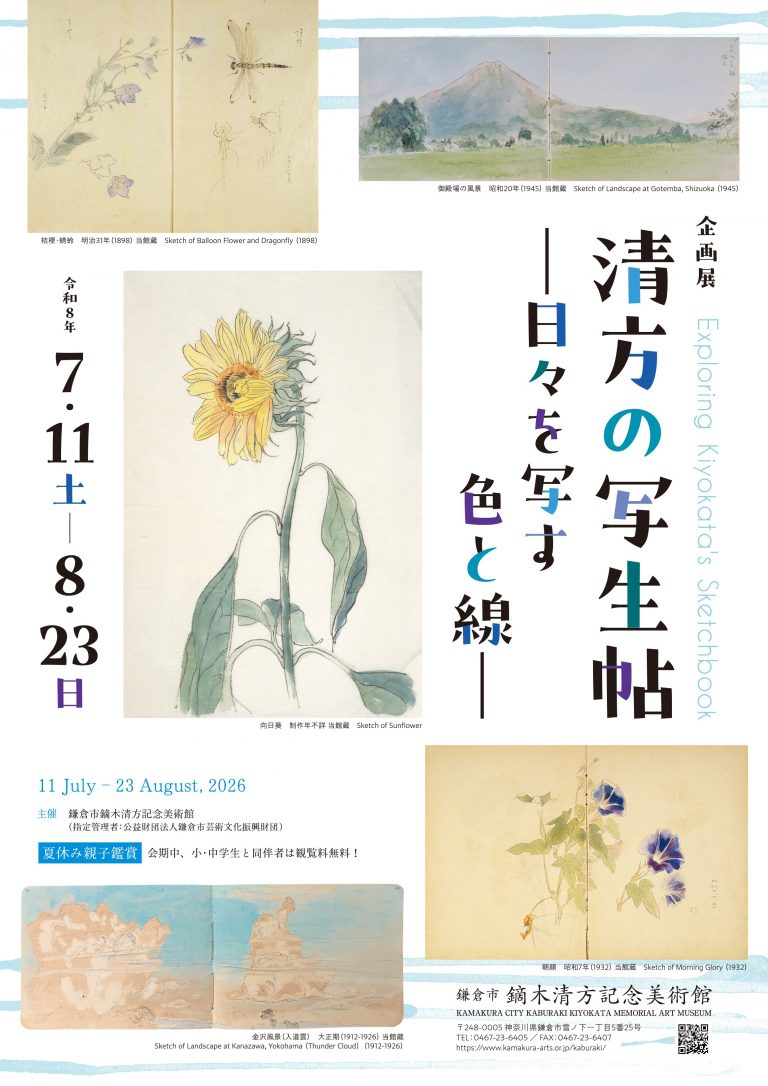
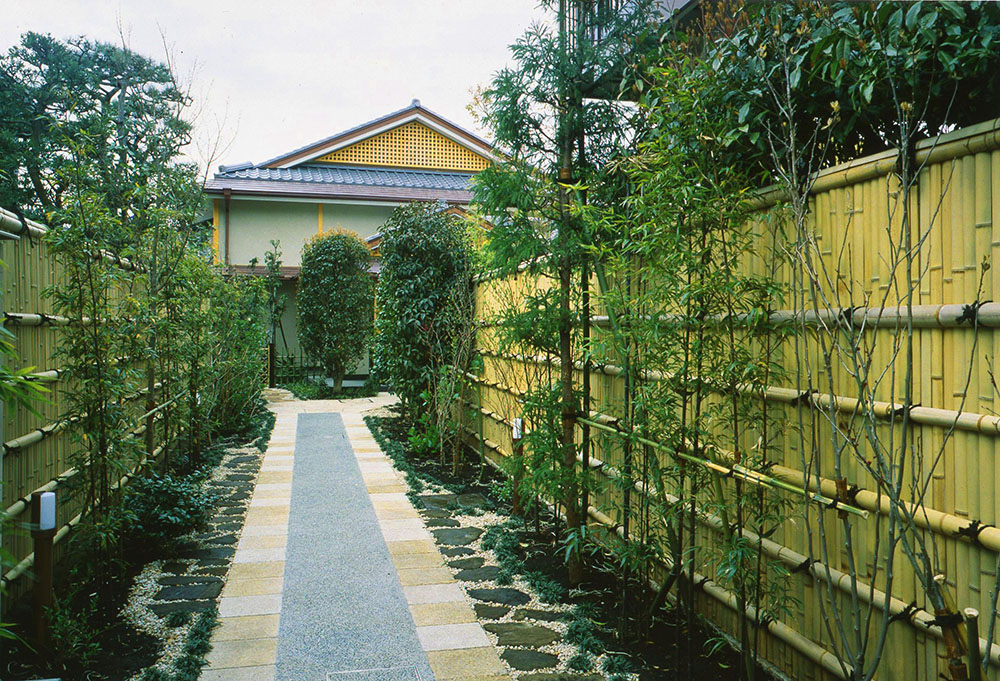
Our museum is built on the site of the former residence of Kiyokata Kaburaki, a master of modern Japanese painting, and the place where he spent his final days in Yukinoshita, Kamakura. The traditional Japanese building stands gracefully amidst the tranquil residential area of the ancient city of Kamakura.
Kiyokata Kaburagi was born in Kanda, Tokyo, in 1878. He grew up surrounded by literature from a young age, and his artistic career began as an illustrator. Later, he turned to painting, and his works, which mainly depicted the pure and graceful figures of women, the lively lives of ordinary people, portraits, and literature he loved, such as that of Ichiyo Higuchi and Kyoka Izumi, convey a sense of empathy and compassion for ordinary people. His connection to Kamakura began in 1946 when he established his residence in Zaimokuza. In 1954, the year he received the Order of Culture, he set up a studio here in Yukinoshita, where he lived until his death in 1972 at the age of 93. In his later years, Kaburagi described his state of mind as "playing in the sentiments of the common people," and he created many works depicting the lives of ordinary people. He left behind many evocative Japanese paintings and essays written in an elegant style.
In 1994, his family donated his artwork, documents, land, and buildings to Kamakura City with the hope that his artistic career and creative space would be preserved for future generations. Following this, the memorial museum opened in April 1998. We hope that visitors will enjoy a peaceful time while reflecting on Kiyokata's art and life.


![Image of [Advance registration required] Bird feather observation eve ・・・](https://magcul.net/wp-content/uploads/2026/07/202406221004_28891-360x252.gif)