Immerse yourself in Taro Okamoto's "playfulness"! Before saying goodbye to his paintings for a while.
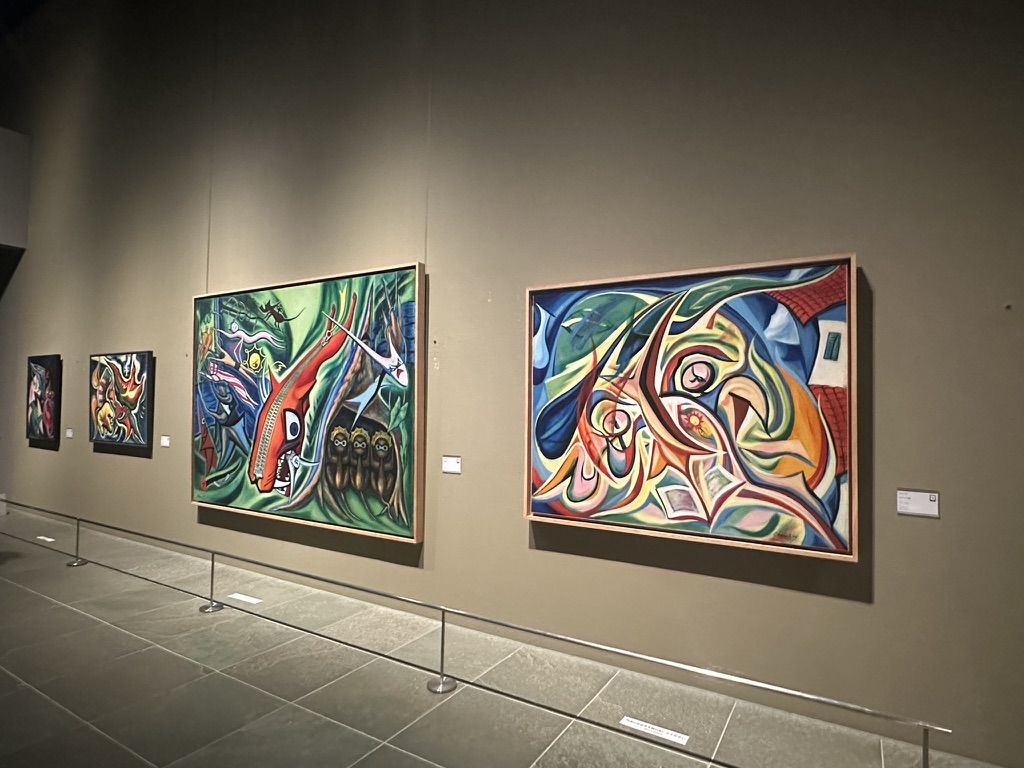
The Osaka World Expo, which was a huge success this summer, may have prompted some people to learn about, reminisce about, or even visit the Osaka World Expo from 55 years ago. At the same time, it's likely that appreciation for and interest in Taro Okamoto, the creator of the Tower of the Sun, which could be considered the symbol of the expo, also increased.
Born in Takatsu Village (now Takatsu Ward, Kawasaki City), Taro donated many of his works to Kawasaki City during his lifetime. In response, Kawasaki City opened the Kawasaki City Taro Okamoto Museum of Art in 1999 in a corner of the vast and nature-rich Ikuta Ryokuchi Park, and for over 25 years it has been a beloved place where people can easily appreciate the works of this extraordinary artist.
Due to the aging of the facilities and equipment, it has been decided to close the exhibition rooms for renovations over a period of approximately three years, from the end of March 2026 to March 2029.
However, paintings displayed without glass or other protective coverings are sensitive to sunlight and temperature fluctuations, and can only be exhibited in exhibition rooms, meaning they will be unavailable for viewing for the time being.
Currently, the museum is holding a permanent exhibition, "Taro Okamoto: To Live is to Play," featuring representative works by Taro Okamoto from its collection, until March 29, 2026, just before its temporary closure.
It's only a temporary closure of the exhibition rooms, and the entire museum isn't shutting down, so you can still view the artwork, especially the three-dimensional pieces, and there are also special events planned outside the exhibition rooms.
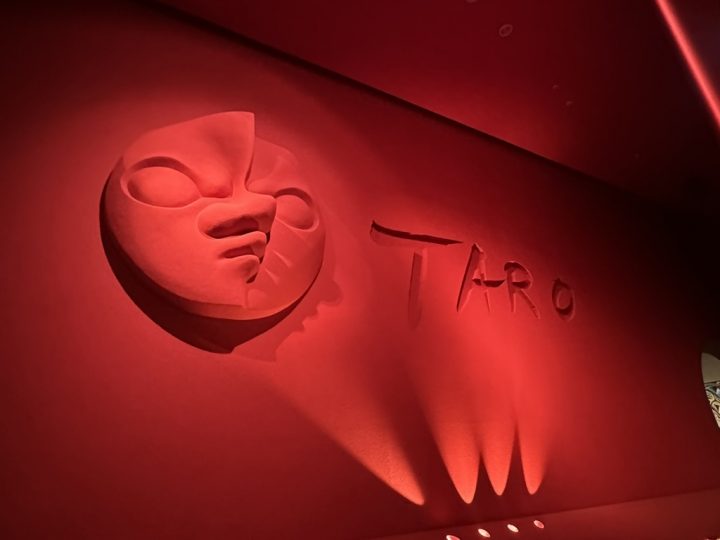
The "TARO World" begins at the entrance to the permanent exhibition room, where the word "TARO" and a face reminiscent of the Tower of the Sun appear against a bright red wall. Then, in the exhibition room's "Introduction," Taro's own words are written: "In this life, set your own destiny, and gamble on it, playing with joy... That is what is worth 'living.' However, that play must be played with your entire being, even if it means shedding blood." Source: Taro Okamoto, "Art and Play—The Point of Crisis," *The Spell of Primary Colors* (1968, Bungei Shunju) This gives you a sense of readiness to enter the TARO World that follows.
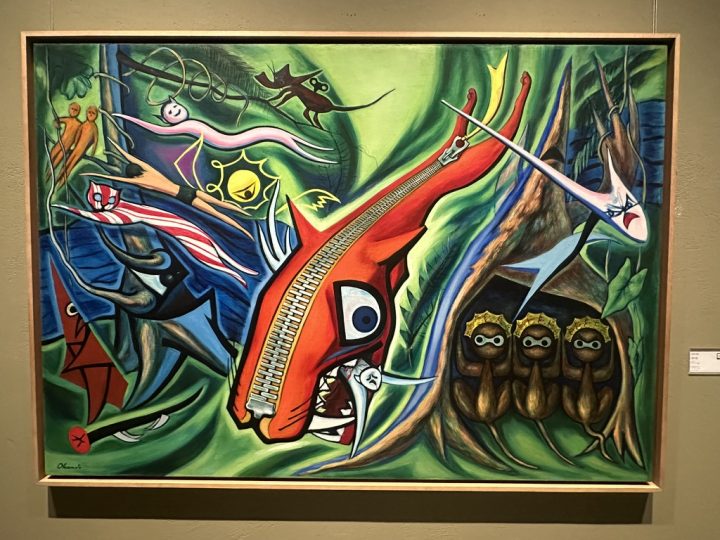
Upon entering the exhibition room, one immediately encounters "The Law of the Forest" (1950), said to embody the "polarism" advocated by Taro, who studied philosophy at the Faculty of Letters, University of Paris. The red monster depicted in the center is a symbol of "power" that threatens its surroundings, but it is said to represent the fact that once the zipper is opened and its contents are revealed, it is utterly insignificant.
As Taro stated, “Contrastism” is “a disharmonious treatment that has not been tolerated until today, namely the juxtaposition of abstract and surreal elements in their contradictory state. Inorganic and organic, abstract and concrete, attraction and repulsion, love and hate, beauty and ugliness—all these torn entanglements result in a fierce dissonance” (Illustrated Essays: Avant-Garde Art, Getsuyo Shobo, 1948). The viewer is compelled to examine every corner of the work to find out where that dissonance comes from.

And opposite "The Law of the Forest" is "Heavy Industry," another representative work of polarism. Painted the year before "The Law of the Forest" (1949), this work also depicts opposites, with "realistic gears," "abstract figures" surrounding them, and "realistic leeks" below them, while also containing social satire.
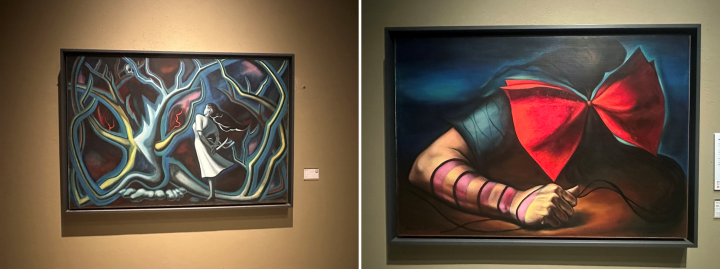
To the left of "Heavy Industry" is "Night" (1947), which also gave its name to the "Night Society" that Taro and his comrades formed to promote the avant-garde, and to the right is "The Wounded Arm" (original 1936, remade 1949), a reproduction of a work from his time in Paris that was lost in the war.
"Night" has gloomy colors, while "Wounded Arm" is expressionistic. Both, unlike the earlier "Law of the Forest" and "Heavy Industry," offer a glimpse into how Taro arrived at "polarism."
The first room (although there's no designated route) is quite impressive, and you could easily spend an hour in just that room.
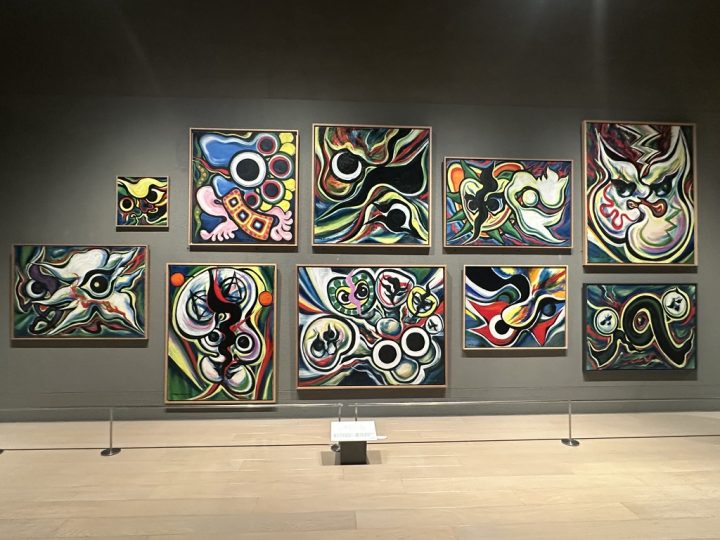
Following that, he continued to produce a variety of works with diverse themes and time periods, including "Spoiled Child" (1951), "Playing Child" (1954), "Warrior in Battle Attire" (1962), "Thousand-Armed Man" (1965), "Portrait on the Beach" (1973), the "Eye Painting" series (1973-1992), and the "Playing Letters" series (1974-1988).
Chairs are placed here and there, allowing visitors to view the artwork from a distance for extended periods.
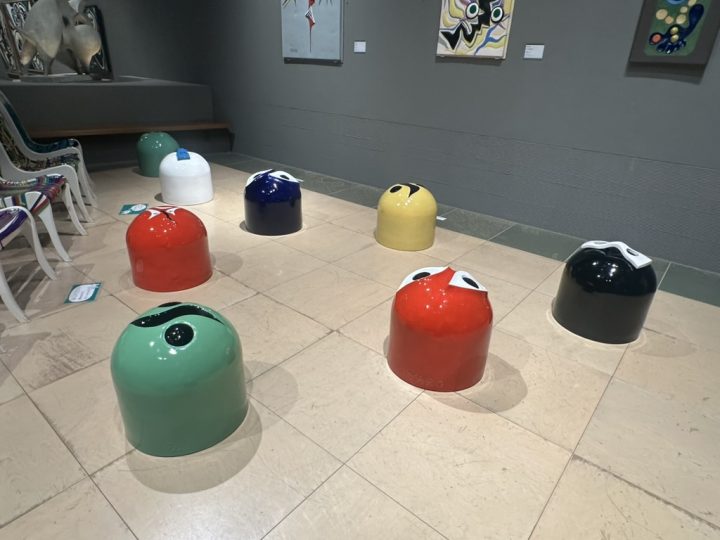
In one corner, there is a rather unusual chair designed and made by Taro, and visitors can actually sit on it.
These are precious works that you can actually touch, such as those shaped like hands, or those with seats and backrests made of string.
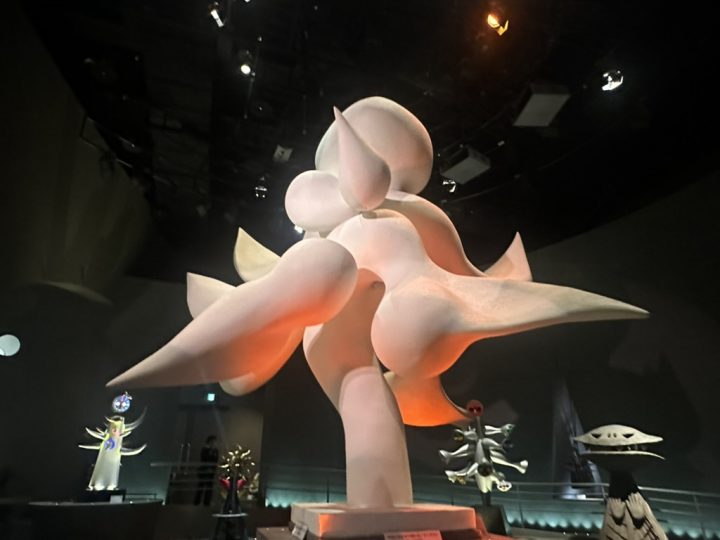
In addition to paintings, photographs, sculptures, and ceramic works are displayed in various forms and locations, such as gentle slopes, glass cases, and terraced rooms, each suited to its purpose.
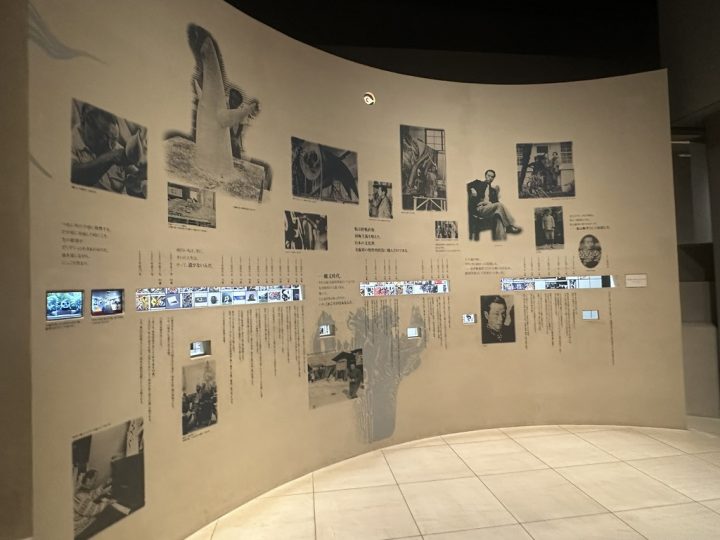
Furthermore, the numerous words left behind by Taro serve as an essential element that allows us to more deeply appreciate the theme of this exhibition: "play (life = play)."
The words written in the timeline, "It's really interesting, isn't it? My life is. Because there's no path," seem to symbolize Taro's "playful" life, where he always followed what captivated him, as a pioneer, and enjoyed it to the fullest while suffering deeply.
The new year and the end of the fiscal year are times when we inevitably reflect on our lives and consider what lies ahead. Exploring the lives of artists who stayed true to their own philosophies might offer a different perspective.