"Walk in THE Yokohama" THE 1st "Yokohama Neighbors" Series Part 1
"Yokohama, a port city where people gather, stop, and start walking again."
This is a series of articles that explore various locations in Yokohama through works of fiction set in the city.
Titled "Walk in THE Yokohama"
What kind of color does the city of Yokohama give to the work?
Also, what is Yokohama like from the author's perspective?
The first work to be serialized is the "Yokohama Neighbors" series by Keiya Iwai!
<Synopsis>
Ryuichi Koyanagi, nicknamed "Ron," is known as the "Great Detective of Yamashita Town" after solving a certain case during his high school days. He had intended to inherit the famous Sichuan restaurant "Suigyokuro" in Chinatown, but the restaurant closed down. Although he works multiple part-time jobs, he mostly just lazes around at home, constantly being told by his grandfather to "find a job."
Various incidents occur around Ron, and he becomes involved in them in many different ways.
Helping Ron are Zhao Songxiong, nicknamed "Matsu," a gambler and black belt in Brazilian Jiu-Jitsu who also grew up in Chinatown; Hinako Kikuchi, nicknamed "Hina,"
<Series>
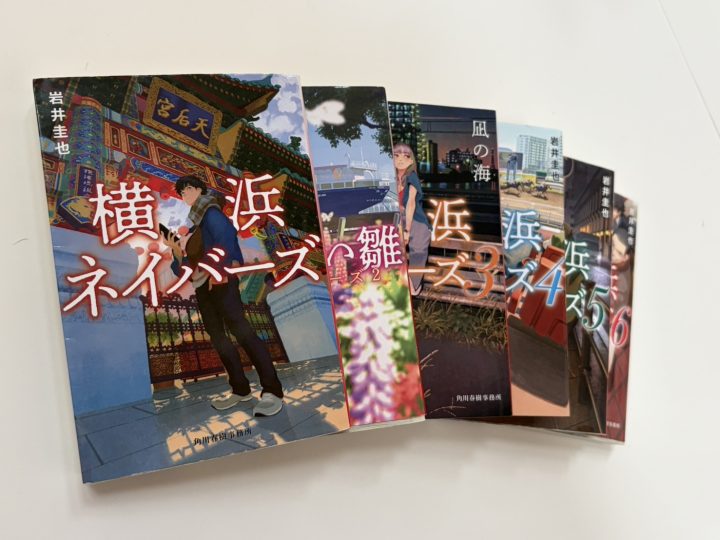
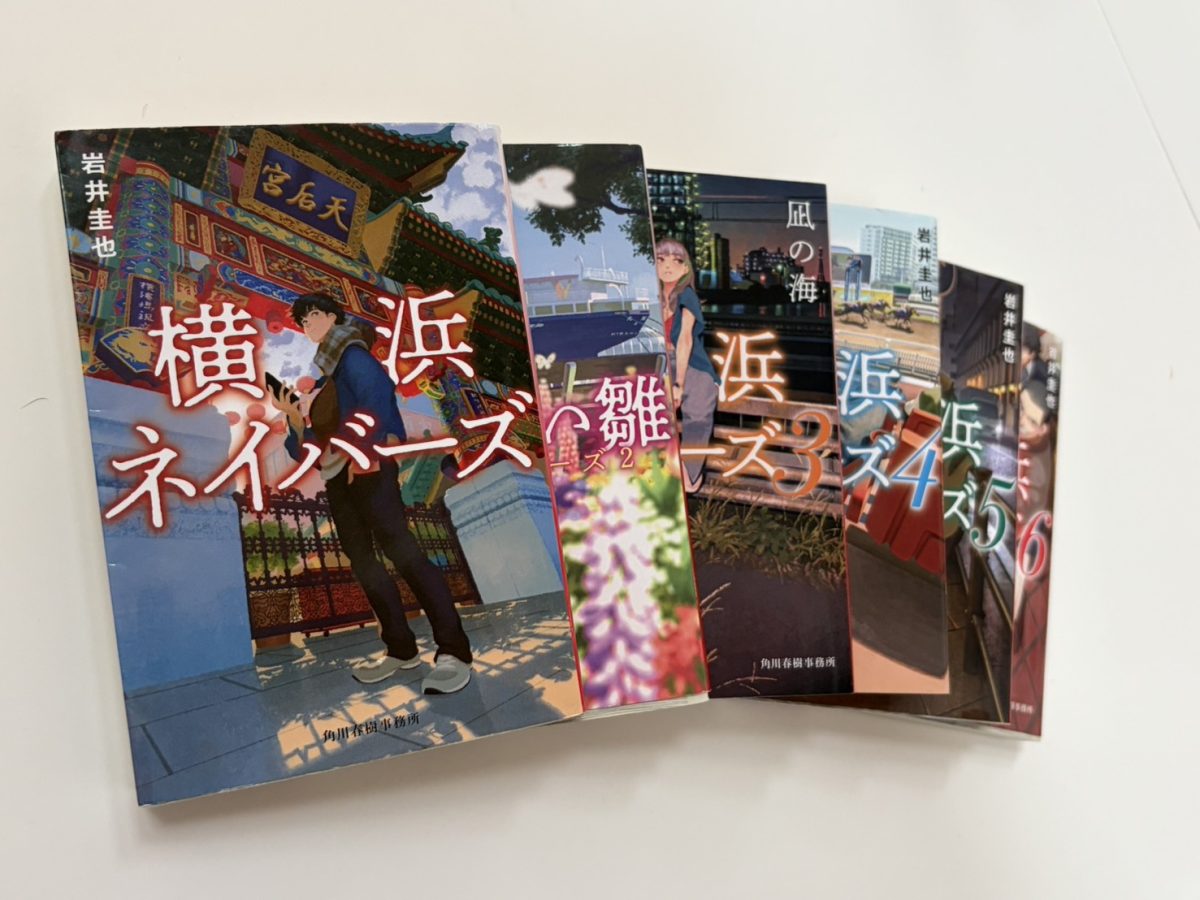
(Kadokawa Haruki Office (Haruki Bunko) / *Volumes 1-5 are a series of self-contained short stories, and Volume 6 concludes the first season)
Yokohama Neighbors (2023)
"Flightless Chicks: Yokohama Neighbors 2" (2023)
"Nagi no Umi Yokohama Neighbors 3" (2023)
"Life Gambling: Yokohama Neighbors 4" (2024)
"Detective High: Yokohama Neighbors 5" (2024)
"Children of Chinatown: Yokohama Neighbors 6" (2025) *Feature film, first season concludes
"Get Out of the Cage! Yokohama Neighbors Special" (2026)
Walk in THE Yokohama Neighbors
The appeal of "Yokohama Neighbors" lies in how the city of Yokohama itself comes alive, almost like a character in the story. From here, let's actually retrace the locations depicted in the work and explore the role that these landscapes play in the narrative. Let's explore "Yokohama as seen through the work," a side you won't find in guidebooks. First, let's start walking from the origin of the story, the Zenrin Gate in Chinatown.
Zenrin Gate (Chinatown)
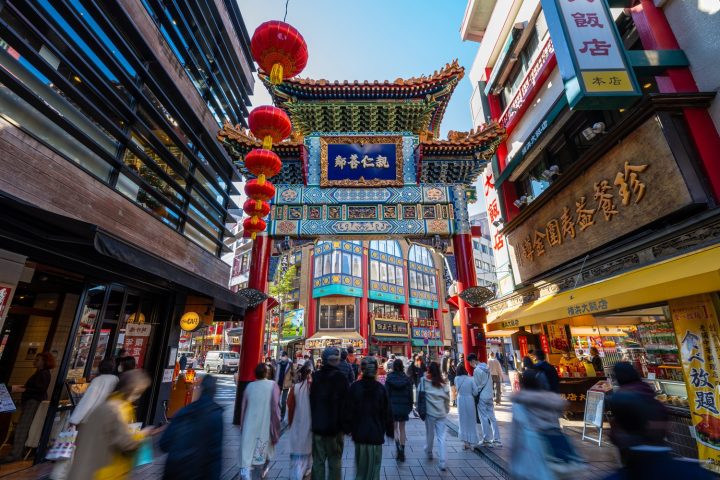
"Chinjin Zenrin" is a phrase originating from the Chinese historical text "Zuo Zhuan" and means "to get along well with neighboring countries and neighboring houses."
Yokohama Neighbors
The story begins here.
The four characters "Shinjin Zenrin" (meaning "be kind to one's neighbor") inscribed on the gate are the central theme of the entire work. As the author reveals in the second part, the story, which he had been unable to write, finally began to move forward here, supported by the central theme of "helping one's neighbor." This is both the starting point and the birthplace of the work's very philosophy.
Yoko Nishi (Yokohama Station West Exit)
"I think everyone at Yokonishi has either thought about wanting to die at some point, or is currently thinking about it. ...However, in reality, most of them don't choose suicide. They just drift through life, even though they want to die. Including myself."
"Falling Girl"
A fictional place modeled after "Toyoko" in Shinjuku.
This fictional place, inspired by "To-yoko," is positioned as a symbol for young people who feel lost and struggle to live. It represents the original landscape of the "neighbors" to whom Ron reaches out, and is the corner where the contemporary reality that the work observes is most intensely present.
Mazu Temple (Chinatown)
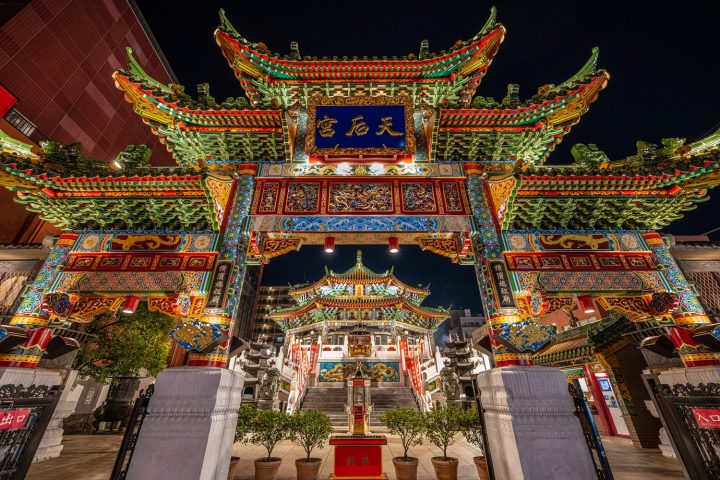
The venue where the countdown to the Spring Festival, a major event in Chinatown, takes place, is a festive space. It is depicted as a place where the vibrant hustle and bustle coexist with the events lurking in the shadows—the light and shadow of Chinatown.
"The Ghost of Bairdman"
Mazu Temple → South Gate Silk Road → Chaoyang Gate → Yamashita Park (Chinatown)
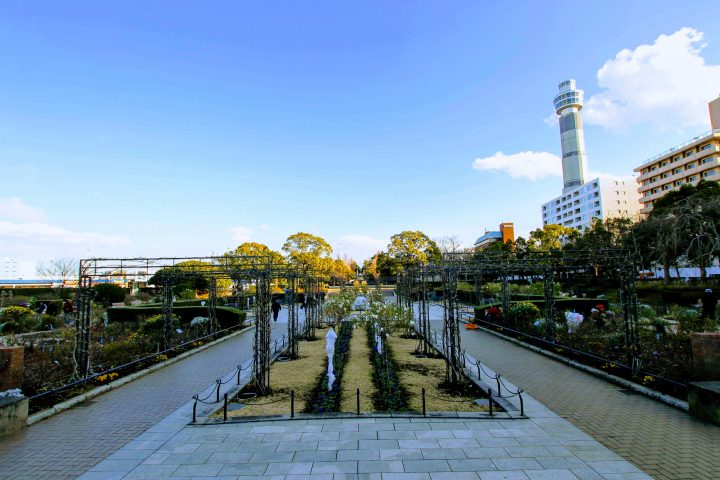
Ron and Matsu are running off in the midst of a certain incident, carrying something with them.
The route that Ron and Matsu run along is a reflection of their physical sense of being in their "hometown." Their intimate knowledge of the land becomes the driving force that propels the story forward.
Kagacho Police Station (Chinatown)
This is the police station located in Chinatown, to which Kin-chan was transferred from the Kanagawa Prefectural Police Investigation Division 1.
The real-life police station serves as a pivotal point that connects Kin-chan, the childhood friend and detective, to the story. It demonstrates how "crimes" and "investigations" exist seamlessly within the everyday city.
Koganecho Area Management Center (Koganecho)
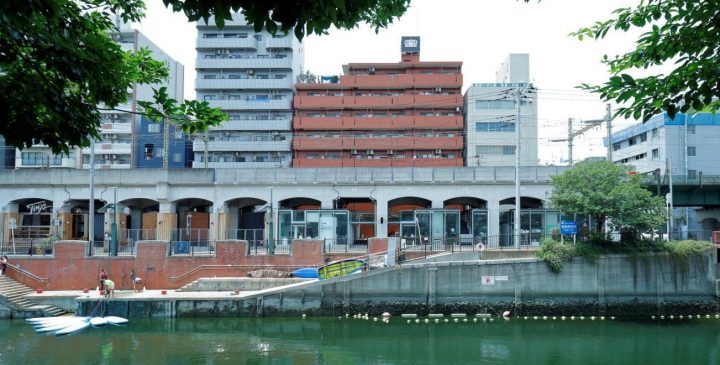
"As long as we're alive, we're bound to hurt others. That's precisely why we find kindness and sincerity towards others so beautiful."
"The Ghost of Bairdman"
Ron, who was looking for the meaning behind the stickers that had been plastered around Chinatown in a way that spoiled the scenery, was told by an artist introduced by Nagi.
Koganecho, a town that has worked together to rewrite its past negative history, is a fitting setting to discuss the work's ethics, which is "to strive for honesty precisely because it hurts others."
Minatomirai Station (Minatomirai)
"The area around the ticket gates is fairly busy with people coming and going. Amidst pairs of businessmen and groups that looked like students, there was a woman in a black coat wandering around aimlessly."
--i got you.
The flames of determination ignited once again in Ron's heart.
"Mother's Land"
This is the scene where Ron and his biological mother, Fujiko Nanjo, who has become a land fraudster, are reunited after 12 years.
The gateway to a sophisticated, futuristic city becomes the setting for Ron's most personal fate—a reunion with his biological mother, who has become a land swindler. The stark contrast between the dazzling scenery and the raw drama reflects the multifaceted nature of this city.
Pacifico Yokohama (Minato Mirai)
"Even if it's just one person, if they realize their mistake and choose a different path, if I can help my neighbors—that would be enough."
"A proxy for your favorite idol"
In Yokohama, in addition to the long-established Grand Hall concert venue, there are also conference centers and exhibition halls. Incidentally, the Minato Mirai area also has many other live music venues such as Pia MM Arena, K Arena, and KT Zepp Yokohama. Ron worked part-time as a security guard at Yokohama Arena (Shin-Yokohama) and Yokohama Stadium (Kannai), among others. It is precisely because of the scale of these places that Ron's small "radius" stands out.
Yokohama Park → Onoue-cho → Oebashi → Noge (Kannai area)
"Is it a sin to simply desire happiness and wealth? Shouldn't those who prey on these feelings and extort large sums of money be the ones who should be held accountable?"
"Life is a gamble"
This is the route Ron speeds along on his bicycle, out of consideration for Matsu's important senior. It's a town/area with a different sense of distance between people than Chinatown. The human dramas here continue to challenge Ron and his friends.
Kanagawa Prefectural Police Headquarters (Bashamichi)
"Detective. It was a word that meant both 'investigator' and 'police officer.' They both dedicate themselves to investigating for something important. In that sense, detectives and police officers might be quite similar."
"Detective High"
This is the former workplace of Kin-chan (then in the Kanagawa Prefectural Police Investigation Division 1), who survived escaping from a semi-criminal gang hideout with Ron.
Kin-chan's reasons for becoming a police officer, and his ideals as a police officer, sometimes cause him to go overboard.
Chinatown
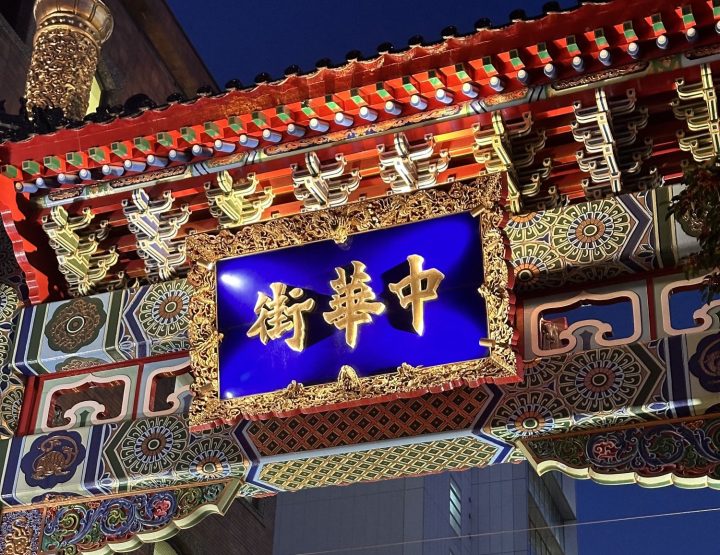
"Ten hours after the onset of labor, I was surprised to find myself holding my crying son in the delivery room. I felt no emotion whatsoever. I was filled with panic. Something was wrong, this wasn't how it was supposed to be."
"Ryuichi was not just my son, but also 'a child of Chinatown,' and at the same time, 'the future heir to Suigyokuro.'"
"Children of Chinatown"
Fujiko, originally from Tohoku, met Koushiro in Chinatown and gave birth to Ryuichi there. Koushiro, the head chef of Suigyokurou, was tied to his restaurant and to Chinatown on the day of the birth and the day of her discharge from the hospital.
Honmoku Wharf (Honmoku)
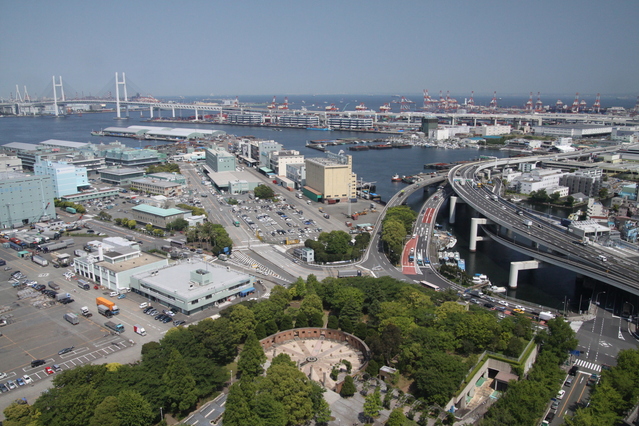
"I'm not saying I'm going to save all of humanity. I act for the sake of the people I'm connected to. But if the people I've helped think the same way, I can make many times, even dozens of times, more people happy. If that chain continues, one day all of humanity will be happy."
"Children of Chinatown"
Ron confronts his mother, Fujiko, who has become a criminal. Ron tries to lure her out of the criminal organization by creating a place for her to belong, but Fujiko retorts, "You can't possibly save all of humanity."
Cafe at MARK IS (Minato Mirai)
"Everyone who's been involved with me taught me that even someone like me has the right to love someone. That it's okay to declare that I love someone."
"Children of Chinatown"
What did Ron, who had been helping his neighbors all this time, finally gain?
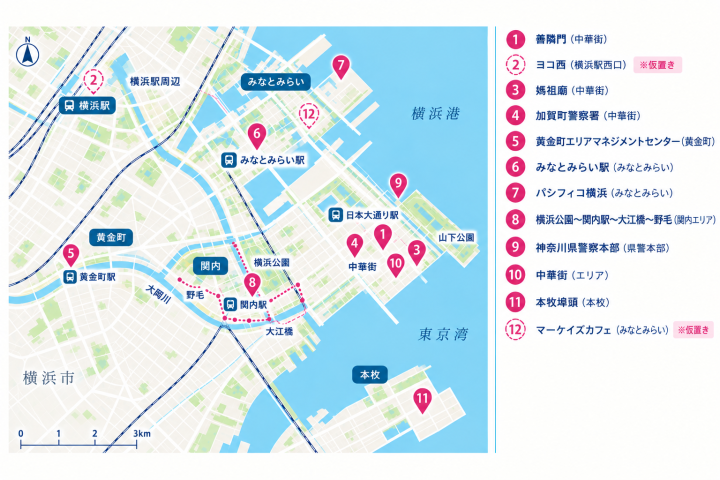
As we trace the route, we see that each and every scene in Yokohama is not merely a backdrop, but a living part of the story. From the Zenrin Gate's "Good neighbors and friendly people" that marked the beginning of it all, to the light and shadow of Minato Mirai, the warmth of the people of Noge, and back to Chinatown—the city itself is depicted with the same intensity as the characters. So, what does the author, Keiya Iwai, who chose and depicted Yokohama, see in this city? In the second part, we will trace the "color" that Yokohama has given to the work, through the author's own words.
<Author Keiya Iwai's Profile>
Keiya Iwai: Born in 1987 in Hirakata City, Osaka Prefecture. Graduated from Hokkaido University Graduate School. In 2018, he won the 9th Wild Era Frontier Literary Award for "Proof of Eternity," marking his debut as a writer. His numerous works include "Body Tattoo," "Poetry of the Living," "The Attendant," "I Am Kumagusu," "Windmill and Giant," the "Yokohama Neighbors" series, and the "Last Appraiser" series. His debut works, "Proof of Eternity" and "Last Appraiser," were both adapted into films and TV shows. The "Yokohama Neighbors" series was also co-produced by Tokai TV and WOWOW, with seasons 1 and 2 broadcast.