At the Kanagawa Traditional Culture Children’s Festival: Kinkaku Takarai on Kōdan and the Appeal of Yokohama

On February 18, 2024, the “Reiwa 5 Kanagawa Traditional Culture Children’s Seasonal Festival” was held, offering the opportunity to experience traditional performing arts and games passed down in Kanagawa and throughout Japan. For this article, we spoke with Kinkaku Takarai, Fifth Generation, a Yokohama-born kōdan storyteller who led a workshop for children.
Top image: Courtesy of Kinkaku Takarai
From a Shy Girl to a Kōdan Storyteller
This year, the event was held at the Kanagawa Prefectural Youth Center, where the appeal of traditional performing arts and traditional games was introduced through six themes across five areas of the venue. Kinkaku led the kōdan workshop, “Discover and Experience! Traditional Performing Arts of Japan.”

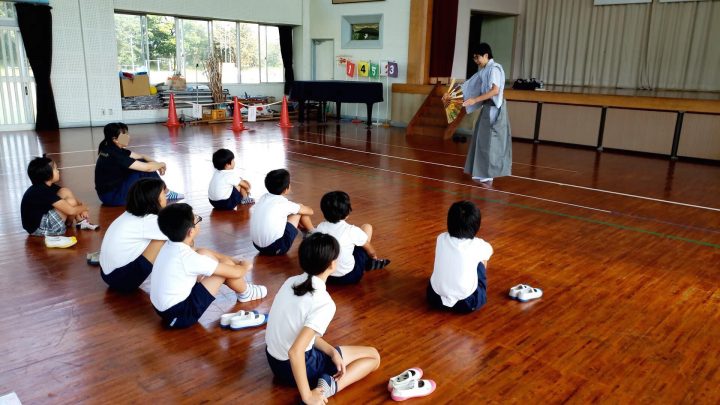
“Reiwa 5 Kanagawa Traditional Culture Children’s Seasonal Festival” kōdan workshop — practice session (Courtesy of Kanagawa Prefectural Youth Center)
— This was your second year leading a kōdan workshop.
Kinkaku This year, five boys and girls from fourth to sixth grade took part. None of them had experienced kōdan before, but we decided that everyone would work together to perform a single piece, with each person taking different parts. After three practice sessions, they took on the challenge of performing it at the final presentation.
— Last year’s piece was “The Soga Brothers,” chosen in connection with the venue in Odawara. What did you choose this time?
Kinkaku I wrote a script based on “The Origin of Odoriba,” an original piece by my teacher, Kinsei Takarai. A typical kōdan performance at a yose theater lasts around 30 minutes, but this time we made it shorter, at around 10 minutes. Titled “A Yokohama Legend: The Origin of Odoriba,” it tells the story behind a memorial monument for cats near Odoriba Station on the Yokohama Municipal Subway Blue Line.
— The participants were elementary school children from Yokohama, just as you were when you were young.
Kinkaku Yes, although I was probably quieter and more shy than they are (laughs). I did enjoy reading, though, and I was praised for reading aloud in Japanese class, so I approached it with confidence.
— I’m also curious about how you first encountered kōdan.
Kinkaku My parents were fans of kōdan and were close friends with my teacher, Kinsei. When I entered junior high school, I wanted to learn “reading aloud,” so I looked for a class but couldn’t find one. Someone suggested that I try kōdan instead, so I joined the Takarai Kōdan Shuraba-juku school. I was by far the youngest student there, but I wanted to develop my strength in reading aloud and use it as a form of expression, so I studied alongside the adults.
— Did you then move naturally into a career in kōdan?
Kinkaku No. I went to university and then found a job with an agricultural publishing department. I liked reading and writing, so I thought I could become an editor or writer. In reality, though, I ended up in sales, traveling around the country visiting farms to introduce and sell agricultural books. During those years, I continued performing kōdan as a hobby and gradually realized what I found so appealing about it: “With kōdan, I can create my own stories and perform them through reading aloud.” So I approached my teacher, Kinsei, again and asked to become his apprentice.

On April 1, 2006, she became an apprentice of Kinsei Takarai and took the name Kinkan Takarai (Courtesy of Kinkaku Takarai)
Two Communication Skills You Can Develop Through Kōdan
After becoming an apprentice, Kinkaku underwent training as a zenza performer before being promoted to futatsume on June 1, 2010, and to shin'uchi on October 14, 2019. Her repertoire spans both classical and new works, with more than 150 pieces.

“Hyakka Ryōran: Kōdan Festival,” August 8, 2023, National Engei Hall (Photo: Osamu Morimatsu / Courtesy of Kinkaku Takarai)
— It has been four years since you took the name Kinkaku Takarai, Fifth Generation, reviving a stage name that had been dormant for 32 years. What do you find appealing about kōdan?
Kinkaku Drawing on my experience of running kōdan workshops for children, which I have continued for around 18 years since joining the Takarai school, I would recommend it as a form of “word play” for children from around the age of three. It’s fun to make sounds while striking the shakudai with a harisen fan, creating a rhythm as you speak. A kōdan storyteller is also a scriptwriter who writes their own scripts, as well as a news anchor who tells stories to an audience. It helps develop both the ability to communicate and performance skills, so I think it can also improve your ability to interact and speak in front of other people.
— The more you learn about kōdan storytellers, the more fascinating they become.
Kinkaku Their roles and subject matter are incredibly diverse. Kōdan has a history of around 500 years, and there are said to be approximately 5,000 different pieces. Kōdan storytellers take everything from historical events dating back to the Heian period and historical figures to foreign history, the latest news and novels, and adapt them in entertaining ways. They are masters of the art of storytelling, capable of making fiction sound like fact through their skillful delivery.
“The Angel of Crimea: Florence Nightingale,” a new work by Kinkaku Takarai, Fifth Generation (Source: YouTube, “Kinkaku Takarai Homebound Kōdan Performance”)
Using Tradition to Share the Appeal of Kanagawa
Kinkaku has also performed many kōdan pieces based on places and stories from Kanagawa, including Enoshima, Kamakura and the Miura Peninsula. She has a particularly strong connection to Yokohama, where she was born and raised, and says the city has many different sides to discover.

“Kōdan Botanical,” July 1, 2022, Chikuhōtei (Photo: Osamu Morimatsu / Courtesy of Kinkaku Takarai)
— What does your hometown of Yokohama mean to you?
Kinkaku It’s not just a stylish port city known for its multicultural spots. It also has a downtown, working-class side, as well as a deeper character as a place where working people gather. I think it’s a city that deserves attention from a historical perspective, too. Yokohama and Kanagawa have many customs and legends that have been passed down for generations. I’d like to continue uncovering these traditions and stories, taking a long-term view.
— On June 23, you have “Kinkaku Takarai Reads Kanagawa (Series No. 9)” coming up.
Kinkaku This time, the piece is “Urashima Tarō.” I was inspired by the fact that one of the many Urashima Tarō legends found throughout Japan is associated with Kanagawa Ward in Yokohama. I hope you’ll look forward to seeing what kind of script I come up with.
After the Kōdan Workshop

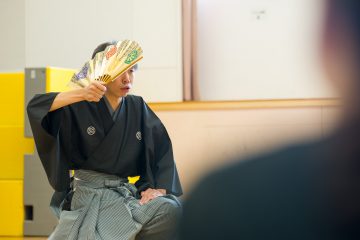
“Reiwa 5 Kanagawa Traditional Culture Children’s Seasonal Festival” kōdan workshop — final presentation (Courtesy of Kanagawa Prefectural Youth Center)
— This year’s Children’s Seasonal Festival has now come to a successful close. Finally, is there anything you would like to say to the children who took part in the kōdan workshop?
Kinkaku First of all, thank you for taking part. I’m glad we were able to work hard together toward the final presentation, sharing our ideas along the way. Treasure this opportunity to discover kōdan! I hope you’ll come and experience a live kōdan performance at least once.

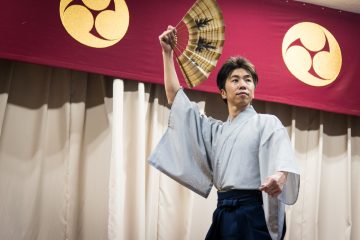
“Reiwa 5 Kanagawa Traditional Culture Children’s Seasonal Festival” kōdan workshop — demonstration performance by the instructor (Courtesy of Kanagawa Prefectural Youth Center)
Kinkaku says she plans to spend 2024 strengthening her foundations and exploring new subject matter. Alongside next year’s Children’s Seasonal Festival, we look forward to seeing what new kōdan pieces inspired by Kanagawa she creates.
Text by Mai Shimura (Editorial Writer)
《Kinkaku Takarai, Fifth Generation》
Kōdan storyteller. Shin'uchi performer and member of the Kōdan Association. Born in Yokohama, Kanagawa Prefecture.
She was exposed to kōdan from an early age and began attending the Takarai Kōdan Shuraba-juku school after entering junior high school. On April 1, 2006, she became an apprentice of Kinsei Takarai and took the name Kinkan Takarai. She was promoted to futatsume on June 1, 2010, and to shin'uchi on October 14, 2019, when she took the stage name Kinkaku Takarai, Fifth Generation.
Official website: here
Performance information: here
・Saturday, May 11, 2024, 2:00 p.m. “Kanagawa Hana Kōza” Yokohama Nishi Public Hall Inquiries: 090-2747-4461 (Sato)
・Sunday, June 23, 2024, 2:00 p.m. “Kinkaku Takarai Reads Kanagawa” Yokohama Nigiwaiza Noge Sha-re Yokohama Nigiwaiza Ticket Hotline: 045-231-2515
《Reiwa 5 Kanagawa Traditional Culture Children’s Seasonal Festival》 *Event concluded*
・Date and time Sunday, February 18, 2024, 10:30 a.m.–4:00 p.m.
・Venue Kanagawa Prefectural Youth Center [9-1 Momijigaoka, Nishi-ku, Yokohama, Kanagawa]
・Official website: here