An experimental challenge that started on intuition and whim might just change the theater world!
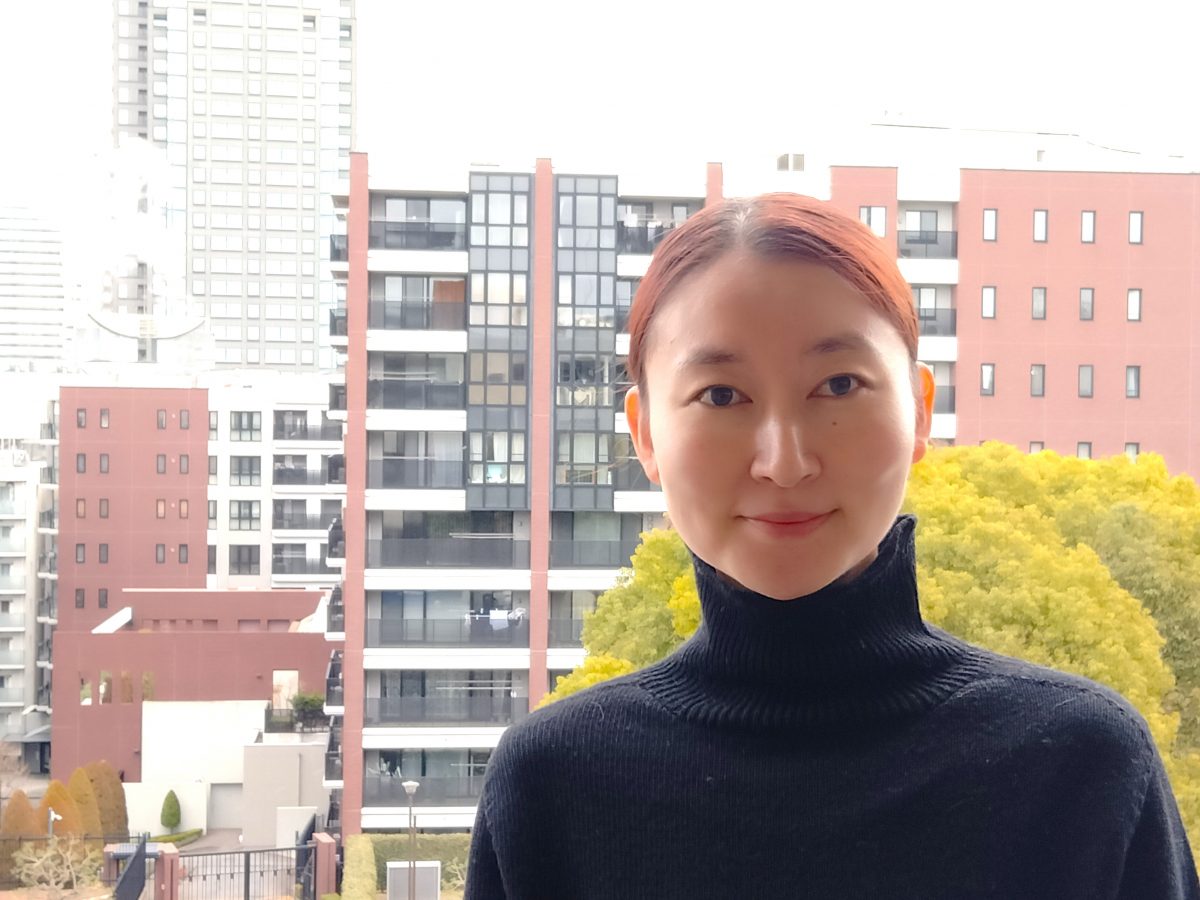
In the 33rd Yomiuri Theater Awards for 2025, five judges recommended Kae Inaba, and three of them gave her the highest score, so she was nominated for the Outstanding Director Award. As expected, she has now won the Outstanding Director Award, making her the undisputed No. 1 young director. Her latest work, "The Endless Room," will be performed at Studio HIKARI in the Prefectural Youth Center.
With anticipation, I checked the website for the work, which stated, "I want to explore the concept of sound. This work is born from sound. Night, distance, whispers, silence, life, death—a musical drama that will be built upon these various questions." A musical drama that explores the concept of sound? Will it discuss views on life and death? I wanted to know more about what kind of work it is! So, I went to interview the creator himself.
—There's very little information available about this film, "The Endless Room," so how did this project come about?
Up until now, the works I've directed have always started with a script, which I would then interpret, draw up a blueprint, and then ask the staff and cast to work with me to create the production. It was always script-first, and I felt like I was becoming a "slave to the book," if I may say so myself. Not that there's anything wrong with that style, but this time I was given the opportunity to try something different, so I thought I'd try starting from scratch without a script.
—What was your reason for choosing "musical theater" for that challenge?
I belong to a theater company called Bungakuza, and I've always worked on straight plays (plays that only use dialogue and no songs), but for some reason, I've been offered work on musicals and musical theater in the last two or three years. I don't dislike music, but I'm not particularly knowledgeable about it either. However, I vaguely felt that "music" is a very "material that should be thought about" when it comes to "theater," and that it's not something that can be answered with one or two works, but rather a theme that should be deeply researched.
I've always felt that, as a Japanese person, my understanding of musical theater differs spiritually from that of Western musicals. I thought that this difference could be interesting, but I also felt that trying to force a Japanese perspective into a mold when creating a translated musical would be difficult. However, when I was offered the job of working on a translated musical, I went ahead without a solution to how to resolve that difference. Fortunately, I was blessed with a great staff and cast, and the performance was a success, but many challenges became apparent.
That's when I got the idea to put on a performance designed to help people experience and understand "sound."
I think that if everyone can freely and equally ask questions and discuss things that are traditionally taken for granted, such as "What does music mean to theater?" or "Why do musicals involve singing?", we can get closer to solving the problem.
Initially, I wanted to try starting from scratch, without any existing scripts, and ultimately, I decided to go with a style where the scriptwriter, director, musician, and performers all contributed their ideas and worked together to create it.
And when I thought about who might be willing to go along with such a risky project, my intuition told me "this person would be good," so I offered the role to those people, and everyone agreed, saying "that sounds interesting," and that's how the current group came together.
—What kind of connections did you have with each of those people?
I've never actually worked with screenwriter Izumi Kasagi before; we only met once for dinner, thanks to a mutual acquaintance who said, "I'm sure you'll get along!" She also gave me a copy of one of her plays, and after reading it, I felt that we have similar linguistic sensibilities and areas of interest.
When I came up with this project, I had no basis for it, but I thought, "Mr. Kasagi might be willing to do it." In fact, when I offered him the job, his response was a very welcome "I see, that sounds interesting."
Then, during our first meeting, the film director whose name came up as an example turned out to be my absolute favorite director. And it was a rather obscure director's name, too. From there, it was like, "Well, you like this one too, right?" "Yes, I do!" It was almost a little scary how much we clicked.
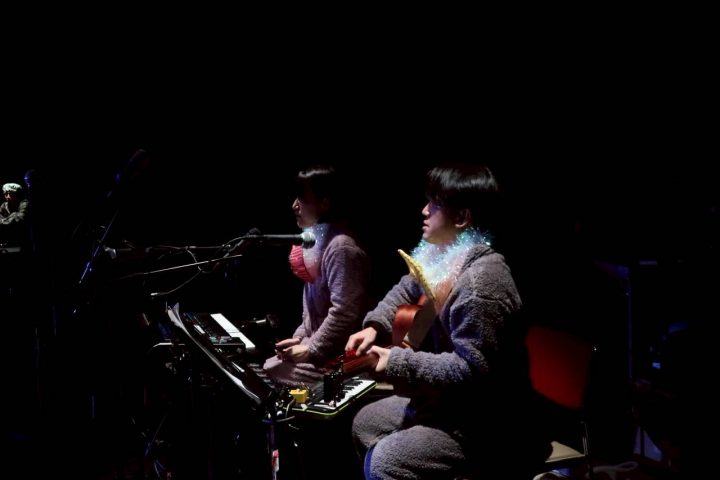
Music director Mugi Furukawa and I worked together on the translated musical I mentioned earlier, and we created the piece while grappling with each other's questions. Yukiko Nishii also played the piano, which was an important motif in that musical. These two have been sharing the questions I've been grappling with for the past three or four years, and they are the people I trust the most.
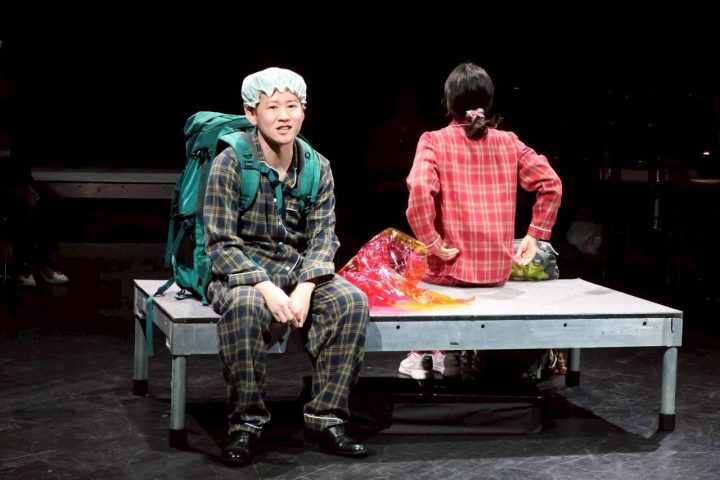
I've only had the pleasure of having a meal with performer Daiki Nishikawa once, but he's someone who primarily works in musicals and personally raises questions about what the current state of the theater world should be. I'm sure he'll agree that this question is something we should all consider together.
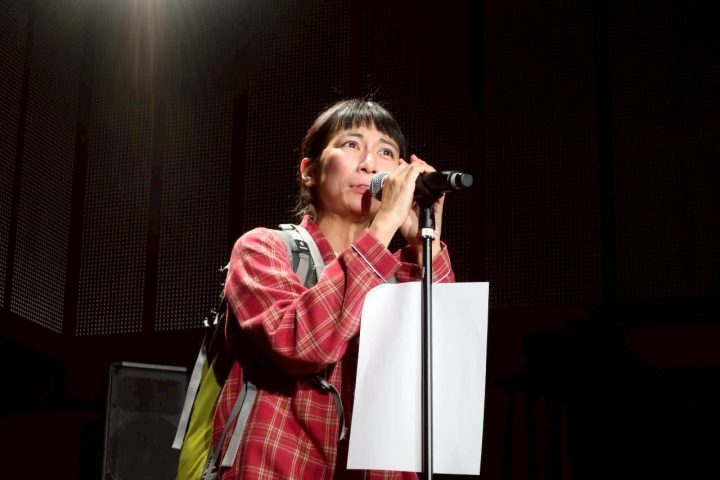
I've worked with Haruko Sekiya and Koichiro Tomioka before. I think Ms. Sekiya is an extremely hard person on herself. I get the feeling that she's always experimenting, especially with musical creation, and she agreed to take on this project, which has no clear destination, saying it "sounds interesting."
Ms. Tomioka also kindly said, "A place for experimentation and challenges is interesting, isn't it? Why didn't you tell me sooner?"
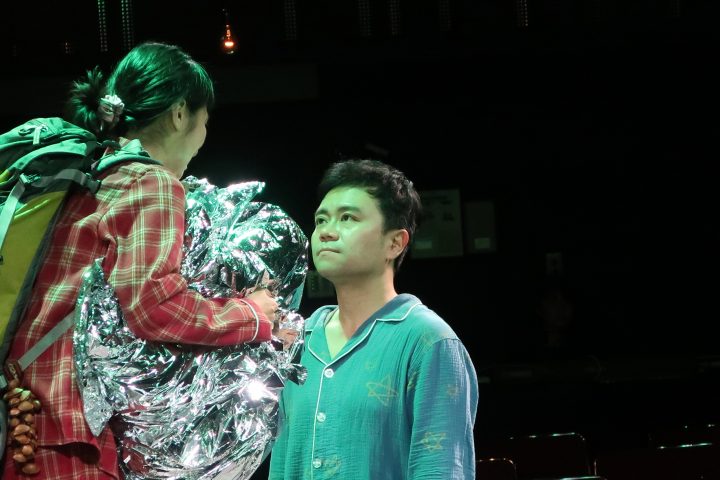
—With this album, which you're creating with such people, have you found answers to the questions you've been grappling with, Inaba-san?
Actually, the work isn't finished yet. (Interviewed on January 22, 2026) But, "I wonder how this will turn out?"
I think that in previous projects, we had put a stopper on ourselves from raising such an obvious question, but this time, bringing it to light and posing the question is clearly linked to the creative process.
Based on everyone's discussions, Ms. Kasagi creates the script as notes, and while using those notes as a framework, we're taking an approach we've never tried before, where we capture the sounds we hear in the moment, such as the air conditioning or someone's cough, and try to move towards the keywords written in the script. For example, instead of me being the only one to understand the concreteness of something vague like "space," we all get together and say, "Oh! That's it!" It's a time-consuming process, but it's thrilling in those moments. I feel like we've managed to embody that thrilling feeling so well that the audience can experience it too.
I do want to find answers to the questions, and I think I'm starting to find them, but this project isn't finished just because it's done. I'm sure higher-level questions and doubts will arise. I think it will probably take me 10 or 20 years to think about them, and there's a big difference between starting and not starting, so I think it's a meaningful step.
—Besides "sound," did any of you make any other requests, especially to scriptwriter Kasagi-san?
I told Ms. Kasagi, "I feel like I often create works that deal with views on life and death." This might be a bit of a leap in logic, but for example, when we stage a Shakespeare play from 400 years ago, the words from 400 years ago are spoken here and now, and I think theater is an art form that gives the feeling that the words of the dead come back to life.
The reason I watch plays is that they allow me to remember or feel connected to important people, things, and times that I have lost, even within stories that have nothing to do with me. I think that's what theater and theaters are like. And I believe that the most powerful element in touching that feeling is sound.
I wanted to create a space where 100 audience members could recall 100 different important memories, so I told them that while Kasagi's own unique script should be strong, it should also allow each person to relive their own personal story.
The sense of unease I feel with musicals and musical plays is that they feel unrealistic when it comes to these personal stories, as if there's a barrier between the stage and the audience. This time, by presenting sound as something more intimate, I think it can become a dialogue rather than one-sided communication.
—Finally, what was the intention behind the title, "The Endless Room"?
It was among the candidates that Ms. Kasagi suggested. I like Michael Ende, and his "The Neverending Story" came to mind. "Neverending" has an image of being both scary and dreamy, and interconnected. On the other hand, "Room" has an image of being personal and alone, so I thought the combination of these opposite words was good. It's also the first time that I've decided on a title before I even have the book.
In the second part of this article , we will introduce the journey of Inaba, who is currently attracting the most attention, to becoming a director, and his future prospects as he approaches his 15th year in the industry.

The 311th Kanagawa Prefectural Youth Arts Theatre production, "The Endless Room" (February 20-23, 2026 @ Studio HIKARI)
This work is born from words and sounds.
Distance, whispers, night, friends, love, silence, death—
A musical play that unfolds using keywords as clues.
A new play by Izumi Kasagi, winner of the 69th Kishida Kunio Drama Award,
Directed by Yoshie Inaba, winner of the 33rd Yomiuri Theater Award for Best Director.
Event information: Click here